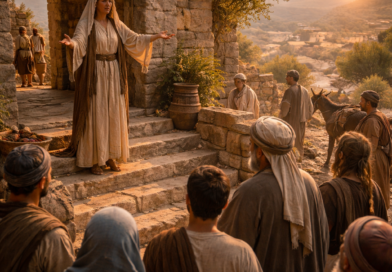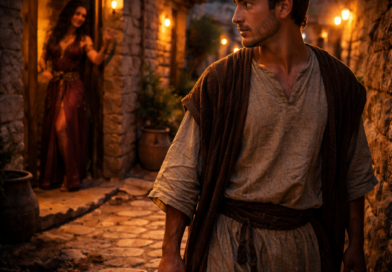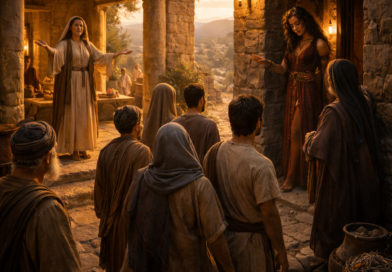
Behold, I stand at the door, and knock if any man hear my voice, and open the door, I will come in to him, and will sup with him, and he with me. Jesus Christ. John 1:17
A man reading the Bible with deep concentration in a vast field

Lament in Exile: Remembering Zion and Crying for Justice.

Psalm 137 is the lament of God’s people in exile, remembering Zion while sitting in sorrow by the rivers of Babylon. It exposes the cruelty of captivity and the humiliation of being demanded to sing songs of the Lord for entertainment, showing that worship cannot be reduced to performance. The psalm insists that forgetting Jerusalem would be a spiritual betrayal, binding memory, identity, and covenant hope together. It also records a cry for God’s justice against those who mocked, plundered, and rejoiced over Jerusalem’s fall—placing vengeance in God’s hands rather than pretending evil is harmless. The chapter is raw and unresolved on purpose: it teaches that God’s people may bring grief and righteous longing for justice to the Lord without sanitizing the pain.

Psalms 137:1 – 137:9

  1 By the rivers of Babylon, there we sat down, yea, we wept, when we remembered Zion.
  2 We hanged our harps upon the willows in the midst thereof.
  3 For there they that carried us away captive required of us a song; and they that wasted us [required of us] mirth, [saying], Sing us [one] of the songs of Zion.
  4 How shall we sing the Lord’s song in a strange land?
  5 If I forget thee, O Jerusalem, let my right hand forget [her cunning].
  6 If I do not remember thee, let my tongue cleave to the roof of my mouth; if I prefer not Jerusalem above my chief joy.
  7 Remember, O Lord, the children of Edom in the day of Jerusalem; who said, Rase [it], rase [it], [even] to the foundation thereof.
  8 O daughter of Babylon, who art to be destroyed; happy [shall he be], that rewardeth thee as thou hast served us.
  9 Happy [shall he be], that taketh and dasheth thy little ones against the stones.

STATEMENT OF FAITH
We Believe…

In one God, eternally existent in three persons – Father, Son, and Holy Spirit;

In the absolute deity and full humanity of our Lord Jesus Christ, God the Son, His virgin birth, His sinless life, His miracles, His substitutionary and atoning death for all through His shed blood, His bodily resurrection, His ascension to the right hand of the Father, and His personal return in power and glory to judge the living and the dead;

In the present ministry of the Holy Spirit, by whose indwelling the Christian is empowered to live a holy life, to witness and work for the Lord Jesus Christ;

In the divine inspiration of all 66 books of the Old and New Testaments as originally given, guaranteeing their infallibility, entire trustworthiness, and supreme authority in all matters of faith and conduct;

That all people are sinners and cannot save themselves. Salvation is received as a free gift of God’s grace, apart from works, through repentance and personal faith in the redemptive work of Christ and the regenerating power of the Holy Spirit;

In the bodily resurrection of both the saved and the lost, the eternal blessedness of the saved, and the eternal punishment of the lost;

In the spiritual unity of believers in our Lord Jesus Christ who are thus members of His Body, the Church, whose work is the worship of God, perfecting the saints, and evangelization of the world.

Follow Us

More relevant content

Latest Post

Exiled Israelites mourning by Babylon’s river with harps hung on willow branches, longing for Zion and remembering Jerusalem in Psalm 137.
 

Lament in Exile: Remembering Zion and Crying for Justice.

Lament in Exile: Remembering Zion and Crying for Justice. Psalm 137 is the lament of God’s people in exile, remembering

Israelite worshipers giving thanks at sunrise in a wilderness landscape, with bread and lamp symbolizing God’s enduring mercy and provision in Psalm 136.
 

Give Thanks to the Lord, for His Mercy Endures Forever.

Give Thanks to the Lord, for His Mercy Endures Forever. Psalm 136 is a structured call to give thanks to

Ancient Israelite worshipers praising the Lord near the temple while neglected carved idols sit in the background, reflecting Psalm 135’s call to living worship.
 

Praise the Lord for His Sovereignty and Mighty Deeds.

Praise the Lord for His Sovereignty and Mighty Deeds. Psalm 135 is a call to wholehearted praise, summoning the servants

Facebook
Twitter
Pinterest
Email
Print